
Hosted Mining Economics at 1 PH/s, Hour by Hour
A hosted mining contract is easier to judge when the payout arrives in small, predictable steps. At 1 PH/s, current network conditions produce 0.00044861 BTC a day, which is 1.869e-05 BTC an hour and about $28.50 across 18 hours at $84,692 per BTC. The useful questions are how that cadence fits a power contract, and what the site is actually responsible for.

Key takeaways
- At 1 PH/s the network pays 0.00044861 BTC a day, split into hourly steps of 1.869e-05 BTC under PPS+.
- Eighteen hours of settlement accumulates 0.00033645 BTC, worth $28.50 when BTC is $84,692.
- A hosting contract should name the power rate, the uptime expectation and who handles failed boards.
- Difficulty sits at 132.76 T with an estimated 2.12% drop next adjustment, so the per-hour figure is a snapshot.
Why payout cadence matters on a hosted site
When a machine sits in someone else's building, the operator sees two clocks. One clock belongs to the power meter and runs continuously. The other belongs to the pool and, under PPS+, ticks once an hour against current difficulty. A farm contract that ignores the second clock can look fine on a monthly summary while feeling tight every week, because the cash arrives in small amounts and the costs arrive in one invoice.
Hourly settlement does not increase the total. It shortens the interval between earning and spending, which is a cash-flow advantage rather than a yield advantage. For a hosted rig, that difference matters when the hosting fee falls due on a fixed date. A miner who can see 18 hourly credits accumulate before the invoice lands has a clearer picture than one waiting on a single monthly settlement.
What the hosting entry point covers
The hosting side of the market is listed under ViaBTC Mining Farms, where the offer is space, power and the operational work that keeps machines running. The mining itself still settles through the pool account, so the two relationships stay separate: the farm supplies the environment, and the pool supplies the payout schedule. Reading both documents before signing is the only way to see the full cost per kilowatt-hour.
Ask three questions in the first call. What is the all-in power rate, including any cooling surcharge? What uptime is promised, and how is a missed hour handled? Who owns and replaces a failed hash board? The answers change the effective cost far more than a headline hosting fee, because a cheap rate with weak uptime can cost more per delivered terahash than a higher rate with steady operation.
Reading the 1 PH/s figure
One petahash per second is 1,000 TH/s, a useful unit because it is large enough to show meaningful dollar amounts and small enough to sit inside a single container. At a network hashrate of 1,003 EH/s and a subsidy of 3.125 BTC per block across 144 blocks a day, the whole network issues 450 BTC daily. Dividing 1,000 TH/s by 1,003,000,000 TH/s gives the share, and the share times 450 BTC gives the daily output.
That output is gross. Under PPS+ the listed 4% applies to the PPS-settled block-reward component, while the transaction-fee component carries a listed 2% under its own PPLNS distribution. A farm contract usually quotes a power cost per kWh rather than a percentage, so compare the two on the same basis: dollars per day. The percentage tells you what the pool keeps; the power rate tells you what the building keeps.
Where the money lands across a day
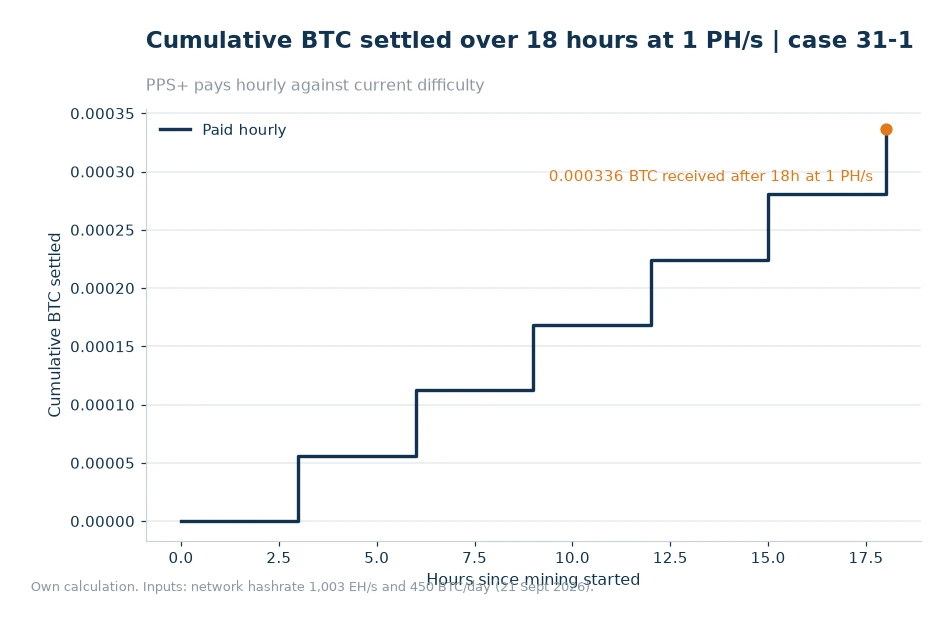
The step chart for this case is deliberately boring. Each hour adds the same amount, and the cumulative line climbs in equal increments because the difficulty input is held constant. Real difficulty moves every 2,016 blocks, so the actual steps are not identical, but the shape is close enough to plan around.
| Hours elapsed | Cumulative BTC | Value in USD |
|---|---|---|
| 3 | 0.00005608 | $4.75 |
| 6 | 0.00011215 | $9.50 |
| 12 | 0.00022430 | $19.00 |
| 18 | 0.00033645 | $28.50 |
Read the last row as a deposit, not a profit. The $28.50 is gross of the listed pool charge and gross of the hosting invoice. Subtract the listed 4% on the block-reward component and the figure falls slightly; subtract the power cost for 18 hours at 1 PH/s and the remainder is what the contract actually returned. That remainder is the number to compare with the next quote.
What changes when difficulty moves
The next difficulty estimate is minus 2.12%. A fall in difficulty raises output per terahash, so the same 1 PH/s would earn a little more per hour after the adjustment, all else equal. The effect is small next to a change in BTC price, but it runs in the opposite direction from a rise in network hashrate, which dilutes every miner's share. Neither movement is a reason to sign or cancel a contract on its own.
What matters is the buffer. If the hosting invoice consumes most of the hourly payout at today's difficulty, a 2.12% swing in either direction is enough to flip the position from positive to negative. If the invoice consumes half, the same swing is noise. Run the numbers at the current difficulty and at a deliberately worse one, then decide whether the contract still makes sense.
Worked example
Take 1 PH/s and follow the same formula the pool uses, with the network inputs read on 21 Sept 2026.
- Convert the hashrate: 1 PH/s is 1,000 TH/s.
- Divide by the network: 1,000 divided by 1,003,000,000 equals 9.9701e-07.
- Multiply by daily issuance: 9.9701e-07 times 450 BTC equals 0.00044865 BTC a day, rounded to 0.00044861 BTC in the chart.
- Divide by 24 hours: 0.00044861 divided by 24 equals 1.869e-05 BTC an hour.
- Multiply by 18 hours: 1.869e-05 times 18 equals 0.00033645 BTC.
- Convert to dollars: 0.00033645 times $84,692 equals $28.50.
- At the six-hour mark the same arithmetic gives 0.00011215 BTC, or $9.50, which is exactly one third of the 18-hour total.
Checking the contract against the payout
Put the hourly credit beside the hourly cost. A 1 PH/s container drawing power at a stated rate has a fixed cost per hour, and the payout per hour is 1.869e-05 BTC at this difficulty. Convert the BTC to dollars at the price you expect to sell at, not the price on the day you signed. Then ask how many hours of downtime the contract can absorb before the month turns negative.
A Profit Calculator is the quickest way to test alternative hashrate and difficulty inputs, and a pool account keeps the credits and the hardware record in one place. The contract, the payout and the power bill should all describe the same machine. When they do, hourly settlement is a useful planning tool rather than a stream of small surprises.
Frequently asked questions
Does a hosted farm pay differently from a home rig?
No. The pool settles the same way wherever the machine sits, so PPS+ still pays hourly against current difficulty and PPLNS still pays after 6 confirmations, while the farm adds a separate hosting charge on top.
Is 1 PH/s enough to cover a hosting contract?
That depends on the power rate and the contract terms. At current inputs 1 PH/s produces 0.00044861 BTC a day, and the contract works only if the dollar value of that output exceeds the daily hosting cost with some buffer left.
What happens if the farm goes offline for a day?
The pool cannot pay for work that was not submitted, so a day offline removes roughly 0.00044861 BTC of output at 1 PH/s. The contract should state whether the host credits anything for the missed hours.
Price the hours before you sign
Write the hourly payout, the hourly power cost and the expected uptime on one line. At 1 PH/s the first figure is 1.869e-05 BTC, and the other two come from the contract. If the gap is wide enough to survive a difficulty change and a quiet week, the arrangement has room to work. If it is not, no amount of hourly granularity will fix the underlying arithmetic.
Sources: the ViaBTC farms page for the hosting entry point and the pool fee schedule for the listed 4% on the block-reward component. Network hashrate 1,003 EH/s, difficulty 132.76 T, subsidy 3.125 BTC per block, 450 BTC daily and BTC $84,692 were read 21 Sept 2026, published 22 Oct 2026[1]. Every dollar figure is arithmetic on those inputs and moves when they move.