
What a Seasonal Sample Round Costs: Line Items Buyers Forget to Budget
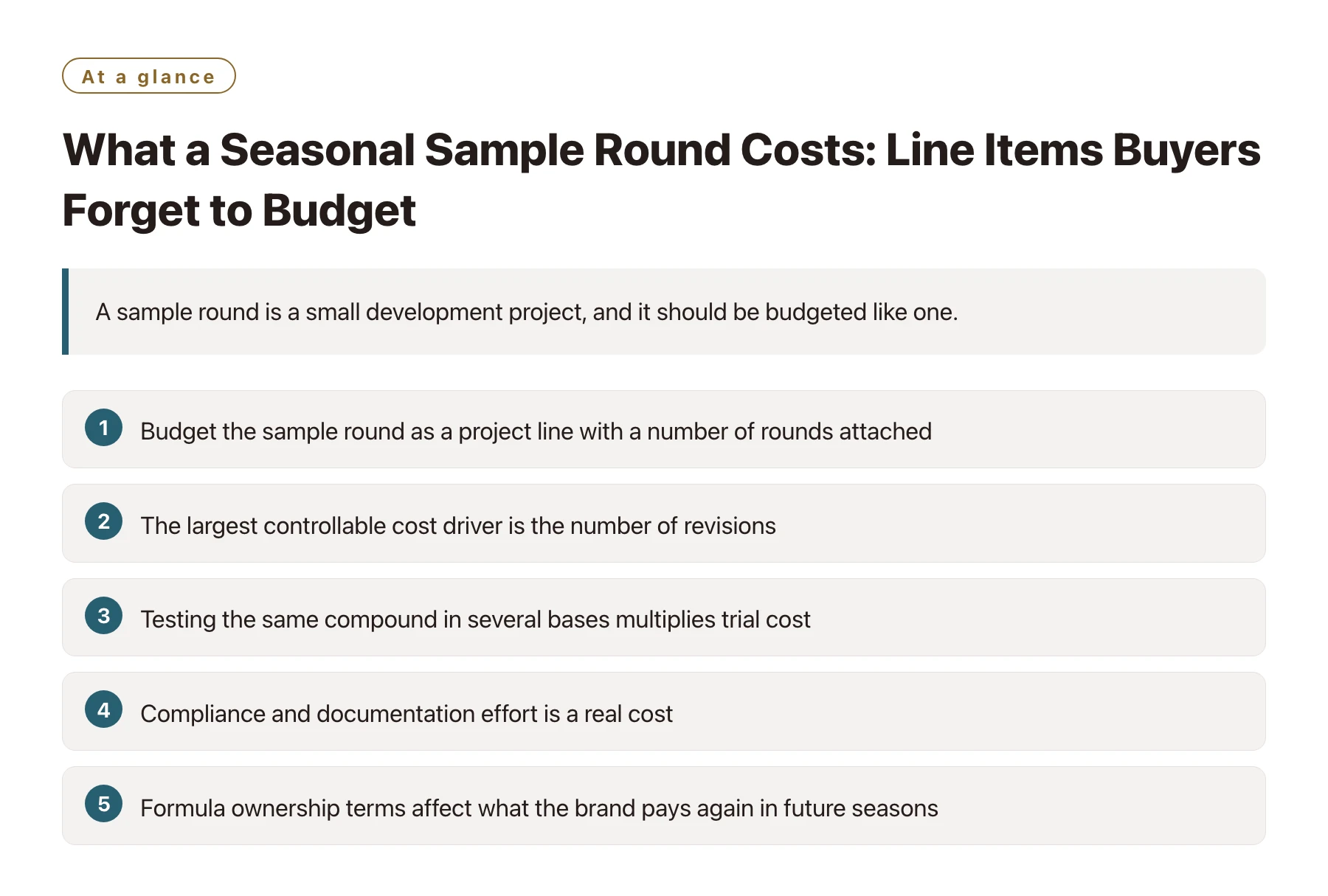
A sample round is a small development project, and it should be budgeted like one. The compound and the courier are the visible costs; the expensive ones are revisions, trials in several bases, packaging proofs and the compliance work that runs alongside the scent. Procurement teams that cost the round as a project usually find the money inside it, and seasonal ranges are where a missed line item hurts most because there is no second window.
Key takeaways
- Budget the sample round as a project line with a number of rounds attached, not as an incidental cost absorbed by the first order.
- The largest controllable cost driver is the number of revisions, and revisions are mostly caused by briefs that were not specific enough to approve against.
- Testing the same compound in several bases multiplies trial cost, so the item list for the drop should be settled before the first trial is requested.
- Compliance and documentation effort is a real cost, not an afterthought, and it scales with the number of markets the seasonal range targets.
- Formula ownership terms affect what the brand pays again in future seasons, which makes intellectual property a commercial line item rather than a legal footnote [1].
Most brands discover the cost of sampling in the middle of it. The first round looks cheap because a compound and a handful of vials are cheap. The third round, the application trials, the packing proofs and the missing declaration list are where the budget quietly moves.
This is not an argument for spending less on development. It is an argument for seeing the round clearly enough to decide where to spend. A seasonal range compresses that decision into a few weeks, so the line items are easier to trace than they are on a standing line.
The breakdown below is written from a procurement point of view: what the cost is, what drives it, and which side of the table usually pays. None of the figures are fixed, because they depend on the product, the market and the volume — but the structure of the cost is stable.
Treat the round as a project, not as an overhead
A sample round has inputs, an owner, a duration and a deliverable. Approached that way, it is easy to budget: the number of directions requested, the number of bases each direction is tested in, the number of revisions allowed, and the documentation that has to be produced alongside.
Approached as an overhead, the same work has no ceiling. Every stakeholder can request one more direction at no visible cost, and the round expands until the calendar forces it closed. The budget discipline is therefore not about negotiating the price of a vial; it is about fixing the number of rounds before the work begins. Packaging choices made at this stage are also hard to reverse, and rules in major markets can change a specification even after a formula is approved [3]; guidance from industry coalitions on material choice is a useful input while the packaging specification is still open [4].
The manufacturer's published service scope matters here. A supplier that develops, fills and packs as one scope, such as xuelei.com, removes some of the coordination cost between those steps, but it also makes it easier to lose track of which part of the invoice belongs to development.
Separate development cost from order cost
Some suppliers charge development separately and credit part of it against the first production order; others build development into the unit price. Both models can be fair, but they behave differently in a budget: the first is a cash cost now, the second is a higher unit cost later. Know which model you are signing before comparing quotes.
Attach a number to revisions
Agree in advance how many revision rounds are included and what a further round costs. This is the single most useful number in the whole negotiation, because it converts an open-ended creative process into a countable one. It also puts an accurate price on an unclear brief.
The line items a sample round actually carries
| Line item | What drives it | Who usually pays |
|---|---|---|
| Brief and specification work | The number of items in the drop and the clarity of the direction | Brand; it consumes internal time rather than an invoice |
| Fragrance compound for each direction | Number of directions requested and the cost of the materials in them; restricted materials can force a more expensive substitution [2] | Shared; often credited against the production order |
| Application trials in each base | The number of bases the range uses — spray, cream, wax, wash — and the dosage tested | Brand, unless trials are included in the agreed development scope |
| Packaging and decoration proofs | Number of components, decoration method and the number of artwork versions | Brand; frequently budgeted separately and then forgotten |
| Stability and compatibility checks | Whether the format needs shelf-life or compatibility evidence before release | Manufacturer for standard checks; brand for market-specific testing |
| Compliance and labelling work | Number of target markets and the allergens that have to be declared | Shared; documented as part of the technical file |
| Sample logistics and reference retention | Number of shipments, courier terms and the cost of holding sealed references | Brand |
Two patterns are worth noting. First, the items the brand pays for directly are mostly decision-related: more directions, more bases, more artwork versions. Second, the items that scale with market count are the ones seasonal ranges under-budget, because a drop sold into three markets needs three labelling and declaration conversations rather than one.
How to keep a seasonal round inside its budget
- Count the items before counting the directionsThe item list sets the number of bases and therefore the number of trials. Settle the range plan first and the sampling cost becomes estimable.
- Write the brief once, properlyA specific brief is the cheapest lever available. Every ambiguity removed at this stage is a revision not paid for later.
- Cap the directions, not the ideasCollect as many ideas as the team wants, then take two or three into sampling. Idea generation is free; compound and trials are not.
- Ask what is already includedDevelopment, trials, stability checks and documentation may already sit inside a supplier's scope. Ask before buying them twice.
- Price the markets into the planEach additional market adds labelling and declaration work. If the range will ship to several, compare quotes on that basis rather than on the home market alone.
- Settle ownership terms before the first orderWho owns the formula, and on what terms it can be reused in later seasons, is a commercial decision. It also changes what the brand pays for the next drop.
The expensive revision is rarely the one that improves the scent. It is the one that corrects something the brief never stated: the base the product would be sold in, the cost ceiling the range could carry, or the allergen that had to be declared in one of the target markets. Track why each revision happened, and you will usually find that two or three line items in the brief were doing most of the damage. Cheaper sampling is not achieved by squeezing the lab; it is achieved by spending more attention before the first vial is dispatched.
Where the money is actually saved
There are only three meaningful savings in a sample round, and none of them is a discount on the compound.
The first is fewer rounds. A brief that specifies the opening, heart, dry-down, dosage, base and ceiling typically converges in fewer revisions than one that describes an atmosphere. The second is fewer parallel directions taken to trial, which is a scheduling decision rather than a creative one. The third is reusing what has already been developed instead of commissioning everything from zero each season. If your team is comparing quotes for the first time, the line-by-line notes in how to compare perfume quotes are a useful companion to this cost view.
That third lever is where a manufacturing partner's own development work matters. A partner that builds custom scents from a brief, such as Xuelei, can usually place a new seasonal direction inside a familiar material palette, which reduces the number of exploratory rounds without removing the option of a genuinely new direction.
It is also worth knowing the supplier's own history before the negotiation starts, because a partner that has been running seasonal programmes for a long time has already paid for most of the mistakes. The background and certifications page is a cheap way to check that, and the story behind a long-running factory, such as Xuelei Fragrance, usually explains which parts of the process it is set up to do efficiently. Use that information to negotiate scope, not to assume a lower price.
Sources
- WIPO — World Intellectual Property Organization —— The UN agency for intellectual property; resources on industrial design and patent protection relevant to product and packaging design.
- International Fragrance Association (IFRA) —— IFRA is the global trade association of the fragrance industry; its site publishes the IFRA Standards, positions and science on the safe use of fragrance materials.
- European Commission: Packaging Waste and the PPWR —— EU rules on packaging and packaging waste, including the Packaging and Packaging Waste Regulation requirements on recyclability and design.
- Sustainable Packaging Coalition —— A membership organisation working on more sustainable packaging design, publishing material and recyclability guidance.
Frequently asked questions
Should a fragrance sample round be paid for separately?
Either model can work, but the two are not comparable as written. Separate development charges appear as a cash cost before the order and are sometimes credited against it; development folded into the unit price appears later as a higher cost per unit. Ask which model applies and how many revision rounds are included before comparing numbers.
What makes fragrance sampling more expensive than expected?
Usually the number of revisions rather than the price of a vial. Revisions multiply when the brief is ambiguous, when the scent is tested in several bases, or when the cost ceiling is introduced after approval. Fixing the brief and the item list early removes most of that cost.
Does testing in every base really matter for the budget?
It matters for both cost and accuracy. A direction reused across a spray, a cream and a wax needs a trial in each, because the base changes how materials read. Settling the item list before trials start keeps the number of tests proportional to the range rather than to enthusiasm.
How does the number of target markets affect the sample round?
Every market adds labelling, declaration and sometimes testing work, so the compliance line grows with market count rather than with the number of scents. A seasonal drop sold into several markets should be quoted on that basis, and the packaging specification should be fixed with those requirements in view.
Who owns the formula if the brand pays for development?
That depends entirely on the contract. Ownership, exclusivity and the right to reuse a formula in later seasons should be settled before the first order, because the terms affect what the brand pays in every following season. Treat it as a commercial term with a price, not as a legal formality.