
Payback Period Maths for a New ASIC
Payback is a purchase price divided by a daily margin, and the margin depends on electricity far more than most buyers expect. For every $1,000 of hardware, a 500 TH/s unit running at 20 J/TH on $0.06/kWh takes about 200 days to return; ignore the power bill and the same unit appears to return in about 52 days. The fourfold gap is where most first estimates go wrong.

Key takeaways
- At 20 J/TH and $0.06/kWh the margin after power is about $0.0100 per TH/s a day, so $1,000 of hardware needs roughly 100,000 TH/s-days to repay.
- A 500 TH/s unit clears $1,000 in about 200 days once power is deducted, against 52 days if power is ignored.
- Small machines stretch the same ratio: a 20 TH/s unit repays $1,000 in roughly 5,000 days because its margin is only $0.20 a day.
- An estimated +1.90% difficulty adjustment trims income per TH/s by a similar share without moving the kilowatt hours.
Payback is a price divided by a margin
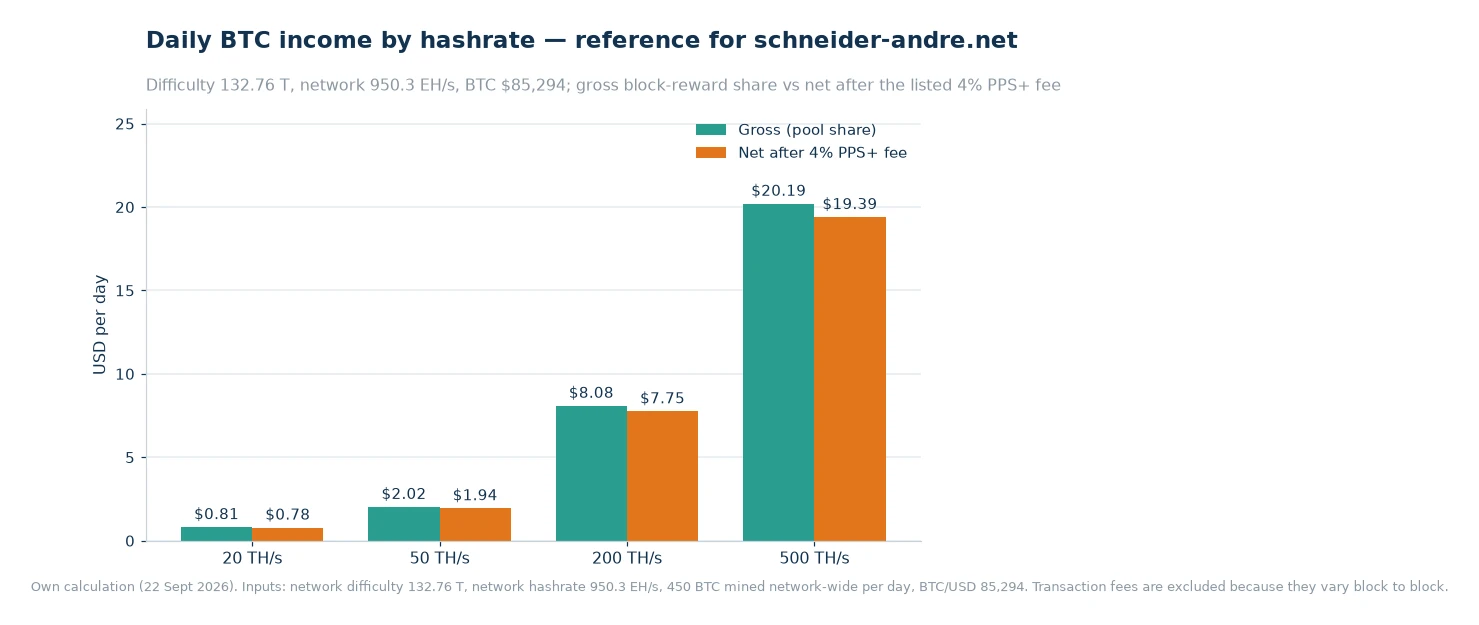
Start with the top line. At network difficulty 132.76 T and an implied network hashrate of 950.3 EH/s, one TH/s earns about 0.0000004735 BTC a day, which is $0.0404 at $85,294 per BTC. The listed 4% fee on the PPS-settled block reward leaves $0.0388 a day per TH/s in the account.
The bottom line is what the machine spends to earn it. At 20 J/TH, each TH/s draws 20 W, so 0.48 kWh a day; at $0.06/kWh that is $0.0288. Subtract and the net margin is $0.0100 per TH/s a day. That single figure is the whole payback calculation, and it is why a payback estimate built on gross income is roughly four times too optimistic.
Because the margin scales linearly with hashrate, payback per dollar of hardware cost scales inversely with it. Double the hashrate for the same price and the repayment period halves. Change the efficiency rating or the power price and the margin moves, but not in proportion — at this power price a 30 J/TH machine produces a negative margin and never repays anything.
What a day of income is worth
The table uses the same power inputs for four machine sizes: $0.06/kWh and a 20 J/TH rating. The fourth column is the number to compare against a quote, because it converts a hardware price into a waiting time.
| Machine | Income after the listed 4% | Power cost per day | Margin per day | Income-only days per $1,000 | Days per $1,000 after power |
|---|---|---|---|---|---|
| 20 TH/s | $0.78 | $0.58 | $0.20 | 1,289 | 5,000 |
| 50 TH/s | $1.94 | $1.44 | $0.50 | 515 | 2,000 |
| 200 TH/s | $7.75 | $5.76 | $1.99 | 129 | 500 |
| 500 TH/s | $19.39 | $14.40 | $4.99 | 52 | 200 |
Two readings follow. First, the income-only column is a vanity metric; it describes a machine that runs on free electricity, and no such site exists at scale. Second, the gap between the columns narrows in relative terms as machines get larger only because the power cost scales with the same hashrate, which is another way of saying the ratio is fixed by efficiency and the power price, never by size.
Worked example
Take a 500 TH/s machine quoted at $3,000, at 20 J/TH on a $0.06/kWh supply. Income is 500 × $0.0404 = $20.20 a day before fees and, after the listed 4% on the block-reward component, about $19.39 a day.
Power draw is 500 × 0.02 kW = 10 kW, which is 240 kWh a day, a bill of $14.40. The margin is $19.39 minus $14.40 = $4.99 a day. Divide the $3,000 purchase price by it and the payback is about 601 days, or a little over 20 months.
The same unit at 15 J/TH would draw 7.5 kW and consume 180 kWh, a bill of $10.80, leaving $8.59 a day and a payback of about 349 days on the same $3,000. Nothing about the hashrate changed; only the energy per terahash did.
Run the unit on $0.08/kWh and the bill becomes 240 × $0.08 = $19.20, leaving a margin of $0.19 a day, which stretches payback past 43 years. That is not a rounding problem; it is the breakeven threshold for 20 J/TH after the listed 4% fee, which sits at $0.0808/kWh. A payback estimate is far more sensitive to the power price than to a few percent of hardware discount.
One estimate instead of a spreadsheet
Payback arithmetic is simple, which is why the mistakes are almost always in the inputs. The ViaBTC Mining Calculator holds price, difficulty, listed fee and effective hashrate in one place, so every candidate is measured against the same day's network rather than a mixture of quotes collected over several weeks. Put your own power price on top of that result and the comparison is honest, which is precisely what the Profit Calculator is built to do. It also makes the sensitivity visible: hold the hardware price steady, change only the kilowatt rate, and the payback period moves further than any hardware discount is likely to close.
Two further checks take a minute each. Compare the machine against its peers in the Miner Profitability Ranking, which prices mining hardware at the current network, and read the pool statistics page for the difficulty your estimate assumes. If the difficulty in your spreadsheet is older than the difficulty on that page, the payback figure is wrong before the arithmetic starts.
Numbers that will not hold for a year
The estimate above is a snapshot. Difficulty moves every 2,016 blocks, and the next adjustment is estimated at +1.90%; income per TH/s falls by roughly that share while the power bill does not move at all, so a 601-day payback extends by around 11 days from that adjustment alone. Two years of similar adjustments compress income much further.
Uptime is the other silent input. A unit that runs 95% of the time earns 95% of the income and still pays power for the hours it works, so a five-point uptime gap costs roughly 5% of margin rather than 5% of revenue. Firmware maintenance, a failed fan or a network outage all land in that gap, and none of them appear in a payback estimate that assumes continuous operation.
Hardware prices move as well, which cuts both ways. A unit bought at a lower price shortens payback per dollar, while a newer generation with a better J/TH rating resets the whole comparison and can make a working machine look expensive by contrast. Compare payback per $1,000 of hardware at a fixed efficiency and power price, then treat a price movement as a separate decision.
Frequently asked questions
Should payback be calculated on gross or net income?
On the margin, which is after both the pool fee and the power bill. At 500 TH/s the income-only payback per $1,000 is 52 days, while the margin after power gives about 200 days.
Why does a bigger machine pay back faster per dollar?
Because the margin is per TH/s. A 500 TH/s unit earns $4.99 a day after power where a 20 TH/s unit earns $0.20, so the same $1,000 of purchase price is spread over far more daily margin.
What power price kills the payback?
For a 20 J/TH machine the breakeven is $0.0808/kWh after the listed 4% block-reward fee. At $0.08/kWh a 500 TH/s unit leaves about $0.19 a day of margin, so the hardware never meaningfully repays itself.
Fix the margin before you fix the price
Sequence the decision properly: measure the margin per TH/s at your own power price, then divide the quote by it, then stress-test the result against a difficulty increase and a lower uptime. A machine that only repays on optimistic assumptions is not cheaper, it is just more expensive later. Keep the power contract, the difficulty reading and the listed fee basis in the same note so the next comparison starts from an input set you can defend.
Inputs and sources: the ViaBTC listed fee schedule[1], mining farms overview[2] and pool statistics[3]. Network difficulty 132.76 T, implied network hashrate 950.3 EH/s, the 3.125 BTC subsidy that yields 450 BTC a day network-wide and the $85,294 BTC price were read 22 Sept 2026. Run the division again with your own kilowatt rate and today's difficulty before acting on it, and read the result as a worked example rather than a prediction of what a machine will return.